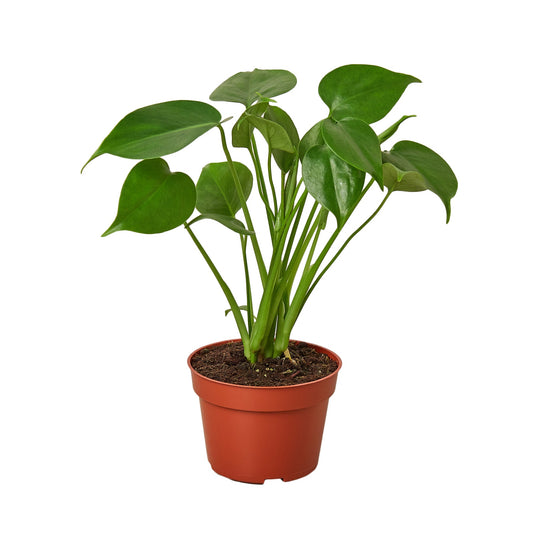
There is a good chance the plant on your shelf is not what the label said it was. If you bought a "mini monstera," a "Monstera minima," a "Monstera Ginny" or a "Philodendron Ginny," you almost certainly own the same plant, and it is none of those things. It is Rhaphidophora tetrasperma, and it is not a Monstera at all.
Before this goes any further, we should say the obvious thing: we have been getting it wrong too. Our own product page for this plant still carries a genus tag that reads Monstera. So this is not a piece about buyers being careless. It is about a naming mistake that the entire houseplant trade inherited, repeated for a decade, and is still repeating today, us included. The interesting part is not that the name is wrong. It is what the wrong name quietly costs you once you own the plant.

How far the mistake actually goes
This is not one rogue nursery with a bad label. NC State Extension, a university reference that most growers treat as authoritative, lists five separate common names for this species, and several of them contain the word Monstera or Philodendron. Plant identification apps return "Monstera minima" for it. Retailers list it under four different names at four different prices. When we ran a photo of our own plant through a botanical identification service while writing this, the top result came back as Monstera minima, with the correct name in second place.
So the confusion is baked in at every level, from the reference books down to the app on your phone. You did not make an error. You inherited one.
Here is what is actually true. Rhaphidophora tetrasperma belongs to Araceae, the aroid family. So do Monstera and Philodendron. They are cousins, which is exactly why the mix-up is so persistent and so forgivable. But cousins are not the same person. Rhaphidophora is its own genus, with its own growth habit, its own mature size and its own timeline. Care advice written for a Monstera deliciosa will point you in roughly the right direction and then mislead you on every specific that matters.
Where it actually comes from
It is native to southern Thailand and peninsular Malaysia, where it climbs tree trunks in warm, humid lowland forest. That climbing habit is the single most important fact about this plant, and we will come back to it, because almost every disappointment people have with it traces back to ignoring it.
For years it moved through the trade as Philodendron "Ginny," a name that stuck because the plant is small, vining and green, and because nobody selling it had a strong reason to look closer. It was genuinely uncommon in cultivation until around 2018. Then it went from collector curiosity to everywhere, almost overnight, on the strength of one thing: it produces split leaves at a size that fits on a bookshelf.
How to tell what you actually have
If you want to settle it yourself, look at the leaf. The splits are the giveaway, and they behave differently in each of these plants.
| Rhaphidophora tetrasperma | Monstera deliciosa | Monstera adansonii | Philodendron (vining types) | |
|---|---|---|---|---|
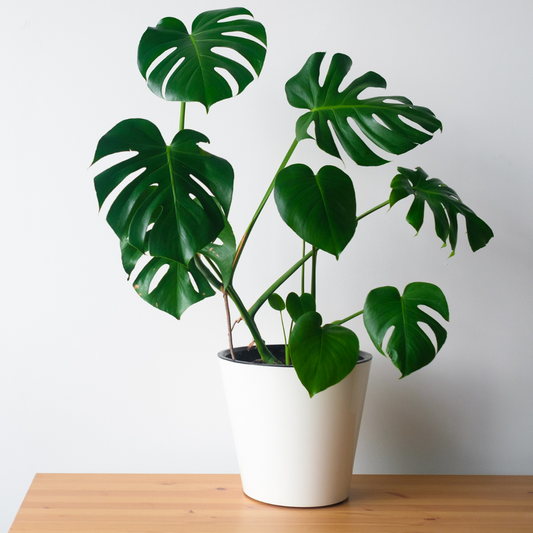
| Leaf shape | Narrow, elongated, deeply cut | Broad, heart shaped, large | Oval, held flat | Heart shaped, entire |
| How the splits work | Cuts run all the way to the leaf edge, open at the margin | Cuts reach the edge, plus interior holes on mature leaves | Closed holes in the leaf interior, edges stay intact | No splits or holes at any age |
| Mature indoor size | Roughly 4 to 6 feet on support, leaves to about 6 inches | 6 to 10 feet, leaves to 2 feet or more | Long trailing vine, leaves to about 10 inches | Long vine, small leaves |
| Growth pace | Fast. A new leaf every one to two weeks in season | Slower, larger increments | Fast, but horizontal | Fast |
| Support needs | Wants to climb. Needs a pole to size up | Wants to climb, eventually needs floor space | Happy trailing or climbing | Happy trailing |
| Correct name | Rhaphidophora tetrasperma | Monstera deliciosa | Monstera adansonii | Philodendron spp. |
The shortcut, if you only remember one line: splits that run off the edge on a small narrow leaf means Rhaphidophora. Holes trapped inside the leaf means adansonii. Enormous heart shaped leaves means deliciosa. No splits at all means Philodendron.
Names you will see it sold under
The correct name is Rhaphidophora tetrasperma. Everything below is the same plant, wearing a different label:
- Mini Monstera
- Monstera minima
- Monstera Ginny
- Philodendron Ginny
- Philodendron Piccolo
- Dwarf Monstera
Worth knowing before you shop, because those names sit on listings at meaningfully different prices. If two sellers are asking very different amounts for what looks like the same small split leaf vine, they probably are selling the same small split leaf vine.
Because it is not a Monstera, it does not behave like one
This is where the name stops being trivia and starts costing you leaves.
Light. It wants bright indirect light. Our own listing tags it for low light, and that tag is not accurate, so we will say plainly what actually happens: in medium or low light this plant survives, but it stops growing and the leaves it does make come out smaller and barely split. People read a low light label, put it in a dim corner, wait six months and conclude the plant is a dud. The plant is fine. It is just being asked to do something it cannot do.
Water. Let the top half to three quarters of the pot dry out, then water thoroughly. It is faster growing than a deliciosa and drinks accordingly in summer, but it will not forgive sitting wet.
Humidity and temperature. Ordinary household humidity is genuinely fine. More humidity simply means bigger leaves, which is worth knowing but is not a requirement. Below about 68F it sulks and slows down. Keep it off cold drafts and away from a window that gets opened in autumn, which matters more than most people expect once heating season starts drying your air out.
Notice what all three of those have in common. None of them are chores. They are consequences of the plant being a fast growing tropical climber rather than a slow, huge, floor standing one.

Every node is a plant
Propagation is where this species stops feeling rare and starts feeling generous. Find a node, which is the small bump on the stem where a leaf and an aerial root emerge. Cut just below it. Put the cutting in water or straight into moist mix. That is the entire method.
Roots typically appear within two to three weeks in water, and the cutting can go into soil once they are an inch or two long. Because the plant pushes a new leaf every one to two weeks in the growing season, a single healthy plant can honestly become three by the end of a summer.
That is also the honest answer to the prices you will see on the rarer sounding listings. This is not a difficult plant to multiply. It was scarce in cultivation for a while, and the scarcity pricing has outlived the scarcity.
It climbs, and that one fact decides what you get
Give it a moss pole or a support and it does what it evolved to do: the stems thicken, the internodes shorten and the leaves get progressively larger and more deeply split as it goes up. Every new leaf outperforms the last one.
Let it hang instead and it will keep growing, keep looking pleasant, and never size up. The leaves stay small and the splits stay shallow, because in the wild a stem with nothing to climb is a stem that has not found its tree yet. It is not a trailing plant that happens to climb. It is a climber that tolerates being left to trail. If a hanging position is what you actually want, we would point you toward the plants built for the drop instead, and toward what a trailing shelf actually looks like six months on.
So the pole is not decoration. It is the difference between the plant you bought and the plant you saw in the photo.
Is it safe around cats and dogs?
No. Rhaphidophora tetrasperma is toxic to cats and dogs. Like the rest of the aroid family, it contains insoluble calcium oxalate crystals, which cause oral irritation, drooling, pain and swelling if chewed, and occasionally vomiting or difficulty swallowing. The ASPCA lists the species by botanical name.
We are not going to soften that. If you have a determined chewer, put this plant somewhere genuinely out of reach or choose something else. Our pet friendly collection exists for exactly this decision, and we keep a fuller breakdown in our guide to pet safe houseplants.
Why it is worth growing anyway
Here is a plant that has been called by the wrong name for its entire commercial life, that gets mistaken for a relative twice its size, and that is still one of the most quietly rewarding things you can keep indoors.
Most plants make you wait. This one reports back. In season you get a new leaf every week or two, and because fenestration develops with maturity, each leaf splits a little further than the one before it. You are not just watching it get bigger. You are watching it visibly grow up, on a timescale short enough that you actually notice.
And it does it at a scale that fits a real home. A Monstera deliciosa asks for floor space and a decade. This one asks for a bookshelf and a pole. That also makes it an easy gift for the person who has been admiring big split leaf plants in other people's houses and does not have the square footage for one.

Questions people ask before they buy
Is Rhaphidophora tetrasperma a Monstera?
No. It is its own genus. Rhaphidophora, Monstera and Philodendron are all members of the aroid family Araceae, which is why they get confused, but Rhaphidophora tetrasperma is not a Monstera species and never has been. The names Mini Monstera, Monstera minima and Monstera Ginny are trade names, not botanical ones.
What is the difference between a mini monstera and a Monstera deliciosa?
Size, pace and leaf structure. A mini monstera stays around 4 to 6 feet indoors on a support with leaves up to roughly 6 inches, and it grows fast, adding a leaf every one to two weeks in season. A Monstera deliciosa reaches 6 to 10 feet with leaves of 2 feet or more, grows in slower and larger increments, and develops interior holes as well as edge splits. They are different genera, not different sizes of the same plant.
Why is it called Philodendron Ginny?
Because it was distributed under that name for years before the correct identification became widely known in the trade. The plant is small, green and vining, which made Philodendron a plausible guess, and once a name is printed on enough labels it becomes very difficult to retire. Several reference sources still list it as an accepted common name.
Is Rhaphidophora tetrasperma toxic to cats and dogs?
Yes. It contains insoluble calcium oxalate crystals, the same mechanism found across the aroid family. Chewing causes oral irritation, drooling, pain and swelling of the mouth and tongue, and sometimes vomiting or difficulty swallowing. The ASPCA lists the species as toxic to both cats and dogs by its botanical name.
Does Rhaphidophora tetrasperma need a moss pole?
It does not need one to stay alive, but it needs one to mature properly. This is a climbing species. Given a pole it thickens its stems and produces progressively larger, more deeply split leaves. Left to trail, it keeps growing but the leaves stay small and the splits stay shallow, because the plant behaves as though it has not yet found something to climb.
Why are my Rhaphidophora leaves not splitting?
Almost always one of two reasons: not enough light, or nothing to climb. Fenestration develops with maturity, and maturity in a climbing aroid depends on vertical growth and adequate light. Move it somewhere bright and indirect, give it a support, and the next few leaves should show the difference. Low light is the more common culprit, and it is made worse by care labels that describe this plant as low light tolerant.
How fast does Rhaphidophora tetrasperma grow?
Quickly. In the growing season, a healthy plant in bright indirect light produces a new leaf roughly every one to two weeks. Growth slows noticeably in autumn and winter as light levels fall, which is normal and not a sign of a problem.
How do you propagate Rhaphidophora tetrasperma?
Take a stem cutting just below a node, the point where a leaf and aerial root emerge, and place it in water or directly into moist potting mix. Roots usually appear within two to three weeks in water, and the cutting can be potted once they reach an inch or two. Every node is capable of becoming a new plant, which is why a single specimen can be multiplied several times over in one season.
If you want one
Ours ships greenhouse-direct, which for a fast growing tropical means it arrives on real growth rather than after weeks in a warehouse, and it is backed by our 30-Day Guarantee. The 4 inch size starts at $26.99, with a 6 inch available if you would rather skip ahead a few months of growing. Free shipping applies on orders over $149.
Buy it under the right name, give it something to climb, and put it somewhere bright. Do those three things and it will spend the next year showing you exactly what it is. You can find it in our rare plants collection, alongside a few other species with reputations that do not quite match their reality, including the Thai Constellation. If you want something more forgiving to start with, our easy care range is a gentler entry point, and you can always browse all plants.