Most houseplants are decoration. You buy them because the leaves look good in the corner, and that is a perfectly fine reason. But every so often a plant shows up carrying something extra, a story, a superstition, a small folded wish, and the braided money tree is the one that does it best. Nobody hands over a fern as a blessing. People have been giving each other money trees for decades to say good luck, new beginnings, may this go well for you.
Quick answer: The money tree (Pachira aquatica, also sold as Guiana chestnut) is a tropical wetland tree grown indoors as a braided sapling. Its palmately compound leaves usually carry five leaflets on young indoor plants, which is where the five elements symbolism comes from, and the woven trunk is believed to trap good fortune inside. It is non toxic to cats and dogs per the ASPCA, tolerates low and office light, and only needs water once the top couple of inches of soil go dry. It is one of the more forgiving statement plants you can own, and easily the most giftable.
Why is it called a money tree?
The name comes from folklore, not botany. The most repeated version of the story is a Taiwanese folk tale about a poor farmer who prayed for a change in fortune, found this unfamiliar tree growing in his field, and made his living propagating and selling it. Fortune, the story goes, came from the plant itself.
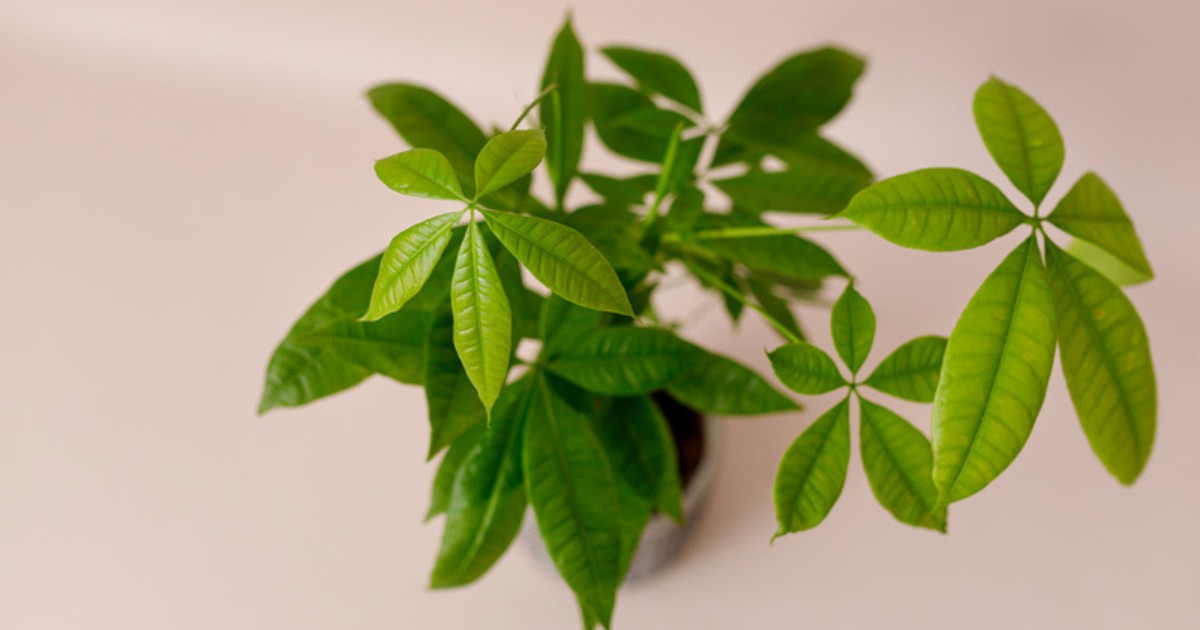
The symbolism stacks up from there. The leaves are palmately compound, and on a young indoor plant they typically fan out in fives, which in feng shui maps onto the five elements: wood, water, earth, fire and metal. A leaf that holds all five reads as balance, and balance is what you want in a space where money and luck are supposed to flow. That is why you will still see money trees at the entrances of restaurants and shops across East Asia, and why they turn up at Lunar New Year, weddings and housewarmings as a standard, understood gift. Older plants often push out six or more leaflets per leaf, which nobody seems to mind.
The plant itself is far older and far bigger than the tradition. Pachira aquatica is native to the swampy floodplains of Central and South America, from southern Mexico down through Brazil, where it grows in standing water and can reach sixty feet with football sized seed pods. The specimen on your desk is the same species, kept small by its pot and its youth.
What does the braided trunk actually mean?
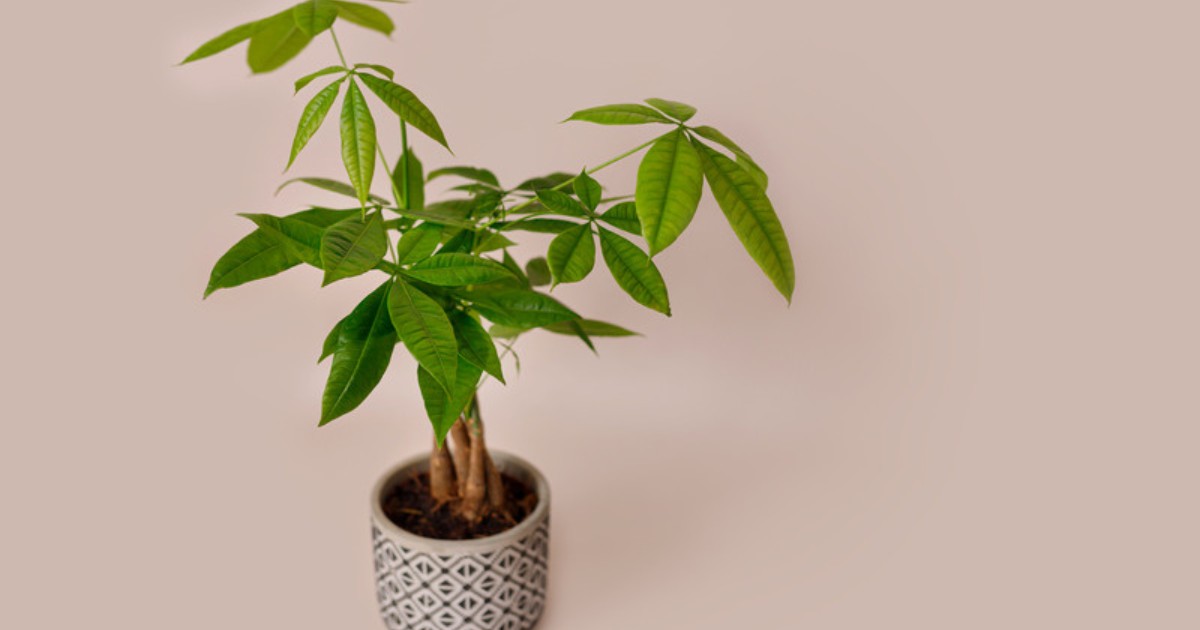
Here is the part most people do not realize: the braid is modern. Wild money trees grow as single straight trunked trees. The braided form was developed by growers in Taiwan in the 1980s, who discovered that several young saplings planted together could be woven while their stems were still green and flexible. As they thickened, the braid set permanently.
It was a horticultural technique first and a symbol second. But the meaning attached almost immediately, and it is a good one: a braid has no open end, so whatever good fortune travels up the trunk has nowhere to escape. Luck gets locked in. Commercially it was a runaway success, because a braided trunk turns an ordinary green plant into something that looks handmade.
Practically speaking, the braid is also why this plant does design work that a trailing vine cannot. You are not looking at foliage in a pot. You are looking at a miniature tree with a visible trunk, a canopy and a silhouette.
Why does this plant feel different from the rest of your collection?
Because you are not really buying decor. You are planting an intention and then watching it grow, which is a strange and quietly moving thing to do with a houseplant.
Think about what most plant purchases are: filling a gap, matching a shelf, replacing something that died. A money tree is the rare one bought toward something. A new apartment. A new job. A business that just opened. A semester that starts in three weeks. The plant becomes a marker for the moment, and unlike a card or a bottle of something, it keeps going. Two years later the trunk is thicker, the canopy is wider, and the fresh start it was bought for has either happened or been replaced by a new one. Either way, the plant kept growing.
That is the whole appeal, and it is worth saying plainly: watching a braided sapling slowly become a tree is the point. If you have been collecting plants for the leaves, this is the one you will end up keeping for the story.
Meet the braided money tree and see the three sizes, from palm sized desk trees up to floor statement pieces.
How do you actually keep a money tree happy?
Short version: bright indirect light, water only when the top couple of inches of soil are dry, never let it sit in standing water, and stop moving it around. That covers most of it. Money trees are forgiving plants, which is a lucky thing for something so often given to people who have never kept one alive.
The two mistakes that kill them are overwatering and direct sun. Despite growing in swamps in the wild, a potted money tree in a living room has nowhere for excess water to go, so soggy soil turns into root rot fast. And those broad soft leaves scorch in a hot south facing window, going pale and crispy at the tips. Bright but filtered is the sweet spot. It will tolerate a dimmer office corner, but be honest with yourself about the tradeoff: in low light it grows slowly, puts out smaller leaves and can shed a fair bit of foliage. Tolerating is not the same as thriving.
| What it wants | What that means in practice |
|---|---|
| Light | Bright indirect. Tolerates low and office light. No direct midday sun. |
| Water | When the top 1 to 2 inches of soil are dry. Let it drain fully before it goes back on the shelf. |
| Temperature | 65 to 80 F. Keep it away from vents, radiators and drafty doorways. |
| Humidity | Average room humidity is fine. 40 to 60 percent is ideal. |
| Feeding | Monthly through spring and summer. Nothing in winter. |
| Size indoors | Up to roughly 6 feet depending on pot size. Prune to keep it compact. |
Two quirks worth knowing. First, money trees dislike being relocated, and a plant that suddenly drops a flush of leaves has usually just been moved or hit with a draft. Pick a spot and commit to it. Second, yellowing leaves are almost always a watering or light problem rather than a nutrient one, so check the soil before you reach for fertilizer. When you do feed during the growing season, working a root focused amendment like Organic Soil and Root Boost into the routine supports the dense root system this plant builds under all that trunk.
Can you propagate a money tree at home?
Yes, and summer is the window. This is the least known thing about money trees and the most satisfying, because it means the plant you were given can become the plant you give.
Take a cutting of green stem, roughly four to six inches, with at least one or two nodes on it. Use clean shears and cut just below a node, then strip the lowest leaves so nothing sits underwater. Dip the cut end in rooting hormone if you have it, which is not mandatory but does improve your odds. Then root it one of two ways. In water, submerge the nodes, change the water weekly, and expect roots in two to four weeks, potting up once they reach an inch or two. Straight into moist well draining soil takes longer, four to eight weeks, but skips the transplant shock entirely.
What you will not get from a cutting is a braid. A braid needs several saplings grown together and woven while young, so a propagated money tree grows as a single trunked tree. That is not a downside, just a different plant. If you want the braid, that has to happen at the nursery stage.
Where should a money tree live in your home?
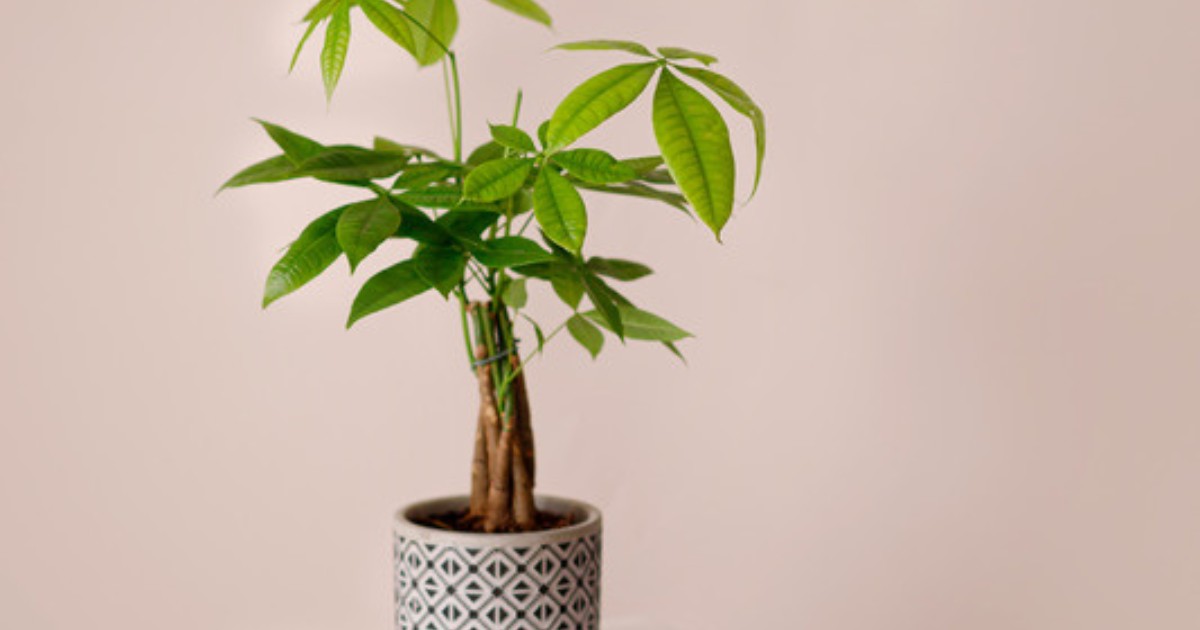
Anywhere you want the eye to stop. The braided trunk gives you vertical structure and negative space between the trunk and the canopy, which is exactly what a room full of soft trailing foliage is usually missing.
The entryway is the traditional placement and the strongest one visually, since a small tree is the first thing a guest registers and the symbolism lands where fortune is supposed to enter. A desk is where the smallest size earns its keep, compact enough to sit beside a monitor and content under mixed office lighting, which is why it belongs in the same conversation as the rest of our desk and small space plants. A larger one anchors a living room corner and reads as furniture rather than clutter.
Terracotta and warm woods flatter the trunk far more than glossy white ceramic does, and raising the pot slightly off the floor makes a mid sized tree look intentional instead of parked.
For pairing, lean into contrast. The money tree brings structure and an upright silhouette, so put soft and trailing next to it. A heartleaf philodendron spilling off a nearby shelf softens the geometry, while an architectural neighbor like Snake Plant Jade echoes the vertical line without competing for attention. Both of those live in the easy care collection, which is a useful place to shop for companions, since plants that forgive the same mistakes tend to survive in the same corner.
Is a money tree toxic to cats and dogs?
No. The ASPCA lists Pachira aquatica as non toxic to cats, dogs and horses, which makes it one of the few genuine statement plants you can put on the floor of a house with a curious animal in it and not think about again.
One important clarification, because this trips people up constantly. Several unrelated plants share the nickname "money plant," and at least two of them are toxic to cats and dogs: jade (Crassula ovata) and pothos, which is sold as money plant in parts of Asia. If you are shopping on the strength of pet safety, the botanical name is what matters, not the common one. The true braided money tree is Pachira aquatica, and it sits in our verified pet friendly plants collection alongside everything else we have checked against ASPCA data. Our full pet safe houseplant guide goes deeper if you are building a whole collection around curious animals.
Why is the money tree the gift people actually remember?
Because the story writes the card for you. "Good luck, trapped in a braid" is a better message than anything you were going to come up with, and it works for almost every occasion that matters: a housewarming, a graduation, a first day at a new job, a wedding, a business opening. Late summer is dense with exactly those moments, between moving season and the start of a new school year, and this is the gift that says fresh start without requiring a speech.
It also outperforms the alternatives on the only measure that counts long term, which is whether the gift still exists in a year. Flowers are gone in a week. A candle gets burned. A money tree is still in the room, still growing, still quietly connected to whoever gave it. That durability is the same reason living plants work so well as employee and client gifts, where a plant on a desk does daily appreciation work that a branded water bottle never will. If you are shopping for someone specific, the perfect plant gifts collection is a good place to start.
The practical worry with gifting a live plant is whether it survives the trip, and that is a fair thing to ask. Plants ship greenhouse-direct rather than sitting in a warehouse, with heat packs added in cold weather, and every order is backed by our 30-Day Guarantee, so a plant that arrives unhappy gets made right. We wrote up what 500 orders taught us about shipping plants alive if you want the unglamorous detail.
Start something
If you have been waiting for a reason, a new chapter is a good one, and a plant that has spent forty years being handed between people as a blessing is a good way to mark it. Pick a size, pick a spot, and let it get taller than the thing you bought it for. Shop the braided money tree, or browse the full range of live plants at plantswagshop.com.
Frequently asked questions
How often should you water a money tree?
In practice this usually lands somewhere between every one and two weeks, but the calendar is the wrong thing to follow. Check the soil instead, since light levels, pot size and season all move the interval around. Overwatering is the single most common way money trees are killed, so when you are unsure, wait another few days.
Why are my money tree leaves turning yellow?
Yellow leaves on a money tree almost always point to water or light rather than nutrients. Overwatering is the first thing to rule out, followed by too much direct sun, then sudden temperature swings from a nearby vent or drafty window. Check whether the soil is staying wet between waterings before you change anything else.
How big does a money tree get indoors?
Indoors a braided money tree typically reaches three to six feet over several years, and pot size is the main limit on how tall it goes. In its native Central and South American wetlands the same species can reach sixty feet. You can keep an indoor one compact indefinitely by pruning the canopy and leaving it in a smaller pot.
Where is the best place to put a money tree?
Bright indirect light, out of direct midday sun, and somewhere you will not need to move it again, since money trees drop leaves when relocated. Entryways are the traditional choice and feng shui practice places them in the southeast corner of a home or room. A desk works too, as long as you accept slower growth in exchange for the convenience.
Do money trees actually bring good luck?
That is folklore rather than fact, and the tradition is more recent than most people assume, dating to 1980s Taiwan rather than ancient practice. What is true is that people have been giving money trees for decades to mark new homes, new jobs and new chapters, so the plant carries real meaning as a gesture even if the fortune part is a story.