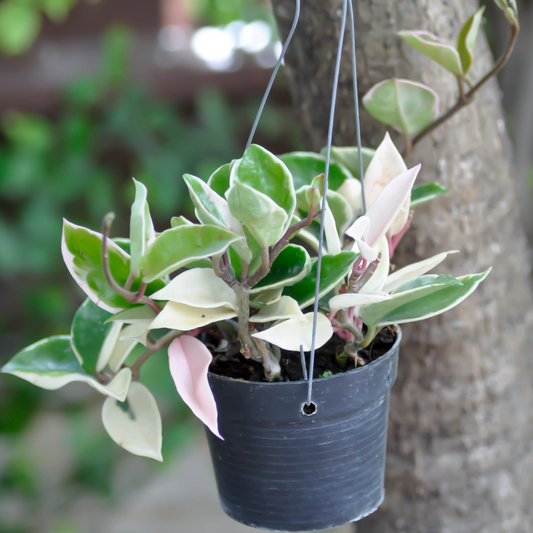

Quick answer: The Hoya Krimson Queen is a variegated cultivar of Hoya carnosa, the wax plant. Its leaves carry cream and white margins around a green center, and brand new leaves emerge almost entirely shell pink before hardening off. It is non-toxic to cats and dogs, it trails or climbs, it tolerates neglect better than almost any other collector plant, and the pink deepens the more bright indirect light it gets.
Most houseplants ask you to be patient for a payoff you cannot see. This one shows its work. Put a Hoya Krimson Queen somewhere bright and the next leaf it pushes out will not be green at all. It arrives the color of the inside of a seashell, soft pink and slightly translucent, and it stays that way for a week or two before the chlorophyll fills in and settles it into cream and green for good. You do not have to wait a season to know you are doing something right. You just have to look at the newest leaf.
That is the whole appeal, and it is why this particular wax plant has become one of the most photographed hoyas around, despite being, botanically speaking, a mutation that a nursery happened to notice and keep.
What exactly is a Hoya Krimson Queen?
Start with the parent. Hoya carnosa is a climbing epiphyte native to East and Southeast Asia (sources vary on the exact range, and some include Australia), where it grows up tree trunks rather than out of the ground, storing water in thick waxy leaves the way a succulent does. Europeans have been growing it indoors since the very early 1800s, when it was named for Thomas Hoy, a head gardener at Syon House. More than two centuries later it is still one of the most forgiving houseplants in cultivation.
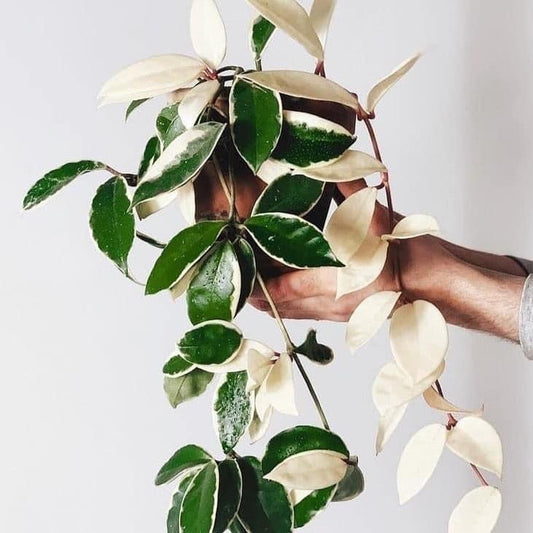
The Krimson Queen is not a separate species. It is a stable variegated sport of that same plant, a spontaneous mutation in which the outer edges of the leaf lose their ability to produce chlorophyll. According to Epic Gardening, it was trademarked in the 1950s under the name Tricolor, and that trademark lapsed in the 1970s, which is why you will still see both names on plant tags today. Green center, cream and white margin, pink new growth. Three colors, one leaf.
This is also where the most common mix-up in the genus lives. Krimson Queen and Krimson Princess are frequently swapped in listings and even in nursery stock, and the difference is simple once you know where to look. On a Queen the variegation is on the outside, a pale border framing a green middle. On a Princess it is on the inside, a pale or pink center surrounded by a green edge. Queen wears her crown around the rim. If you are building out a genus collection deliberately, that distinction is worth checking before you buy, and it is one of the things we look at when we source plants for our rare plants collection.
Is your window right for a Krimson Queen?
That pink only shows up in the right light. Our 1 minute quiz looks at your light, your space and your pets, then points you to plants that will actually thrive there. Take the plant quiz and see whether a hoya belongs on your list.
Why does the pink show up, and how do you keep it?
The pink is not permanent and it is not a defect. New Hoya leaves emerge before they have built out their pigment structure, and in a variegated plant the tissue that would have been white flushes with anthocyanin instead, a red pigment that acts as a natural sunscreen while the leaf is soft and vulnerable. As the leaf matures the anthocyanin fades and the cream comes through.
Two things control how much pink you get. The first is light. In a bright spot the plant produces more anthocyanin, so new growth comes in deeply pink rather than faintly blushed. In a dim corner it will still grow, but the new leaves arrive almost white and the variegation on the older leaves narrows over time as the plant quietly reverts toward plain green in an effort to make more food. The second is growth rate. No new leaves means no pink, so a plant that is dormant, root damaged, or badly overwatered will look static no matter how good the window is.
The practical version: an east facing window, or a spot two to three feet back from a south or west facing one. Enough light that the plant grows, not so much that the pale margins scorch. Variegated tissue has no chlorophyll to protect itself, which is why a Krimson Queen sunburns faster than an all green wax plant and also why it grows more slowly. Less green surface means less photosynthesis. Patience is part of the deal.

What does a Krimson Queen actually need?
Very little, which is the second half of its appeal. This is a plant that punishes attention far more than neglect. The most common way people lose one is by treating it like a fern.
| Light | Bright indirect. East window, or set back from a south or west window. More light means more pink. |
|---|---|
| Water | Let the top 1 to 2 inches of the mix dry out completely, then water thoroughly. The leaves store water, so underwatering is recoverable and overwatering often is not. Ease off further in the cooler, darker months when growth slows. |
| Soil | Fast draining and chunky. Orchid bark or perlite mixed into standard potting soil mimics the bark it grows on in the wild. |
| Pot size | Snug. Hoyas flower more reliably when slightly root bound, so resist the urge to size up early. |
| Temperature | Comfortable room range, roughly 60 to 85 degrees. Keep it off cold glass in winter. |
| Humidity | Average household humidity is fine. It appreciates more but does not require it. |
If a leaf goes soft and yellow near the base of the vine, that is almost always water sitting too long, not a lack of it. If the leaves pucker slightly and the plant feels light, it is thirsty and will plump back up within a day of a proper soak.
How do you propagate a Hoya Krimson Queen?
Spring and summer are the easiest times, because the plant is actively growing and cuttings root fastest in warm conditions. Cuttings taken in a cooler, dimmer stretch of the year still root, just more slowly, so give them the warmest bright spot you have. Be honest with yourself about pace: this is a slow grower, and a Krimson Queen cutting is a project measured in months, not weeks.
Take a stem cutting four to six inches long with at least two or three nodes on it, which are the small bumps where a leaf meets the stem. Strip the leaves off the lowest node. Put that node in water or in a moist, well draining mix, and keep it somewhere warm and bright but out of direct sun. Roots typically appear in three to six weeks. Once they reach an inch or two, pot the cutting up in the same chunky mix you use for the mother plant.
One thing that trips people up: a single leaf will root, and it will sit there looking healthy for years, but it will never become a plant. Hoya leaves have no growth point of their own. Without a node in the cutting there is nothing to sprout a new vine from. If you have ever wondered why the leaf you rooted has done absolutely nothing for years, that is why.
There is a second, even easier method called layering. Lay a section of vine across the surface of a small pot of moist mix, pin a node down with a bent paperclip, and leave it attached to the mother plant. Once it roots, snip it free. Because the cutting keeps drinking from the parent the whole time, it is the closest thing to foolproof propagation this plant offers.
Your hoya habit can earn rewards
Collecting hoyas tends to snowball, so let it pay you back. When you shop, you earn Leaves points toward future rewards. Join the rewards program before your next plant comes home.
Where does it belong in your home?
A Krimson Queen wants to go somewhere it can move. Left alone it trails, so it reads beautifully off the top of a bookshelf, from a hanging planter, or spilling sideways out of a plant stand. Give it a small trellis or a hoop and it will climb instead, which changes it from a soft trailing shape into something more architectural and makes the variegation easier to see head on.
Color wise, this is a plant for a quiet background. The tricolor leaf is doing enough work on its own, so it looks best against warm white walls, pale plaster, natural wood, or unglazed terracotta. Against a busy wallpaper or a dark saturated paint it disappears. If you have been leaning into the fewer and more dramatic plants approach, a mature Queen with three feet of trailing vine is exactly the kind of single specimen that carries a whole shelf without any help.
Pair it with texture rather than more pattern. A plain green trailing plant below it, a matte pot, and nothing else. Our full range of trailing and hanging plants is worth a look if you are building out a shelf and want contrast that does not compete.

Hoya Carnosa Krimson Queen
Available in 3 inch and 4 inch pots, plus a 6 inch for a plant with real trailing length already established. Shipped greenhouse-direct, so it arrives straight from the grower rather than from a warehouse shelf.
Does it make a good gift?
It is one of the better plants to give someone who says they are not a plant person, for three reasons that have nothing to do with how it looks.
It survives being forgotten, so it will not quietly die on them and confirm the story they tell about themselves. It is compact in a 3 inch or 4 inch pot, so it fits a dorm desk, a studio windowsill, or an office shelf without becoming a logistical problem. And it changes visibly, which means the recipient gets a small reward every time it pushes out a pink leaf rather than a plant that just sits there. Think of it as a keepsake that grows slowly: a housewarming, a new job, a thank you, a friend who just moved into a first apartment. Just double check the recipient's shipping address at checkout so it lands at the right door.
And once your own plant is established, a rooted cutting in a small pot is one of the most personal gifts a plant person can give. It is a piece of your plant, passed on.
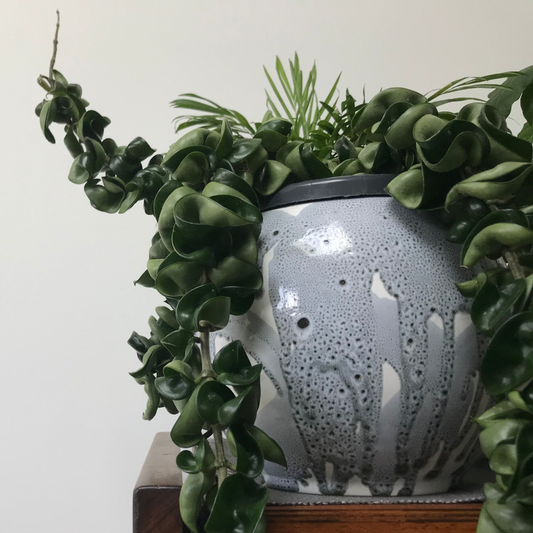
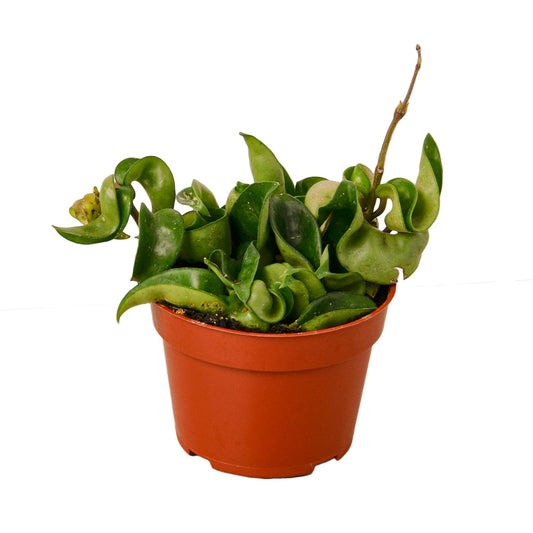
For someone who already collects, the framing shifts. A Krimson Queen is usually the plant that starts a hoya habit, and it pairs naturally with a Hoya Rope Plant for the textural opposite (a different cultivar of the same wax plant species, with tightly curled leaves), or an easygoing Pothos N'Joy for a faster-growing companion. Browse the perfect plant gifts collection for more ideas. If you are not sure where to start, our guide to building a hoya wish list walks through the genus from easiest to rarest.
Is Hoya Krimson Queen safe for cats and dogs?
Yes. The ASPCA lists the wax plant, Hoya carnosa, as non-toxic to cats and dogs, and NC State Extension lists it as non-toxic to horses as well. That puts this plant in a small and useful category: collectible and listed as safe to keep at pet height. It is one of the reasons it turns up so often on shelves in homes with animals.
Two sensible caveats. Cut stems release a milky sap that can irritate skin and mouths, so wipe up after taking cuttings and discourage chewing even though it is non-toxic. And any plant eaten in quantity can cause a stomach upset simply by being indigestible. Non-toxic means it will not poison your cat. It does not mean your cat should eat it. If pet safety is driving your whole plant list, browse the full pet-friendly collection.
Will it ever flower?
It will, and the flowers are the reason people who grow hoyas get slightly obsessive about them. Hoya carnosa produces umbels of small star shaped blooms, pale pink with a deep red center, arranged in a near perfect sphere. They look artificial. They smell like honey and vanilla, strongest in the evening, and they drip nectar.
Getting there takes maturity and a little restraint. The key detail most people miss is that hoyas bloom from the same woody spur year after year, so cutting off a spent flower stalk removes next season's flowers along with it. Leave them attached, even when they look dead. We covered the full picture of what actually triggers blooming in why your hoya isn't flowering, which is worth reading before you make any decisions with pruning shears.
A plant that gives back
We partner with One Tree Planted to give back through tree planting, so the vine trailing off your shelf connects to forests growing far from it. Read more in the plant on your shelf and the tree you will never see.
Why this one is worth the shelf space
Plenty of houseplants are beautiful. Fewer of them let you see the effect of your own care in real time. The Krimson Queen does, and it does it without demanding much in return: an east window, a pot it can stay in for a couple of years, and water only when it asks. A single mutation, noticed and kept by growers decades ago, produced a plant that turns something as ordinary as adequate light into visible pink. That is a good trade.
Every plant arrives backed by our 30-Day Guarantee, and from November through March, adding the winter protection option at checkout keeps that coverage in place. Not sure your light is right? The plant quiz will tell you in about a minute. Browse our easy-care plants, look through the rare plants if you want to go deeper into the collection, or start with a single Krimson Queen and let it convince you. Browse All Plants at plantswagshop.com.
Frequently asked questions
Is Hoya Krimson Queen toxic to cats?
No. The ASPCA lists the wax plant, Hoya carnosa, as non-toxic to cats and dogs, and that includes variegated cultivars like the Krimson Queen. The cut stems do release a milky sap that can irritate skin and mouths, so discourage chewing and wash your hands after taking cuttings, but the plant itself is safe to keep in a home with pets.
What is the difference between Krimson Queen and Krimson Princess?
The variegation sits in different places. A Krimson Queen has cream and white variegation around the outer edge of the leaf with a green center. A Krimson Princess has the pale or pink variegation in the center of the leaf with a green margin around it. The two are frequently mislabeled in listings, so check the leaf edge before you buy.
Why is my Hoya Krimson Queen losing its pink variegation?
Almost always light. Variegated tissue produces anthocyanin, the pink pigment, in response to bright light, so a plant in a dim spot pushes out pale new leaves instead of pink ones and can slowly revert toward solid green. Move it to an east facing window or a few feet back from a brighter one and the next flush of growth should come in with more color.
How often should I water a Hoya Krimson Queen?
Water only when the top 1 to 2 inches of the mix have dried out completely, which in average household conditions usually means every 10 to 14 days in summer and less in winter. The waxy leaves store water like a succulent, so this plant recovers easily from being too dry and rarely recovers from sitting wet.
Is the Hoya Krimson Queen rare?
It is collectible but not genuinely rare. The cultivar has been in commercial circulation since at least the 1950s and is widely available, which is exactly what makes it a good entry point into the genus. The rarer hoyas are far easier to appreciate once you have grown a Krimson Queen and learned how the genus behaves.
How do you propagate a Hoya Krimson Queen?
Take a stem cutting four to six inches long that includes at least two or three nodes, remove the lowest leaves, and root the bare node in water or a moist, well draining mix somewhere warm and bright. Roots usually appear in three to six weeks. A single leaf without a node will root but will never produce a new vine.