
Most houseplants ask you to imagine what they will look like in a year. String of Pearls does not. It shows up already doing the thing, strands of small green spheres pouring over the rim of the pot like a necklace somebody forgot to put away.
It is the plant people photograph before they have even found a spot for it. And it is also, quietly, one of the most misunderstood plants on the shelf, because almost everything about how it looks tells you to treat it in exactly the way that will kill it.
A desert problem that accidentally became beautiful
Curio rowleyanus comes from the semi-desert scrub of South Africa's Eastern Cape. In the wild it does not hang from anything. It creeps along the ground in the shade of rocks and larger plants, rooting wherever a node touches soil, spreading into dense living mats that hold moisture underneath them.
The pearls are the whole design. A sphere holds the most water for the least surface area, which is exactly what you want when rain is unreliable and the sun is not. The trade-off is that a sphere is terrible at collecting light, so each pearl carries a narrow translucent stripe, an epidermal window that lets light down into the photosynthetic tissue inside. It is a plant that solved an engineering problem and came out looking like jewelry by accident.
You will see it sold under two names. It was described for decades as Senecio rowleyanus, named for Gordon Rowley, the British botanist who spent his career on succulents, and many sellers including our own product page still use that name. Taxonomists have since moved it into the genus Curio. Both names point at the same plant, and it is a member of the daisy family either way.
Why it stops people mid-sentence
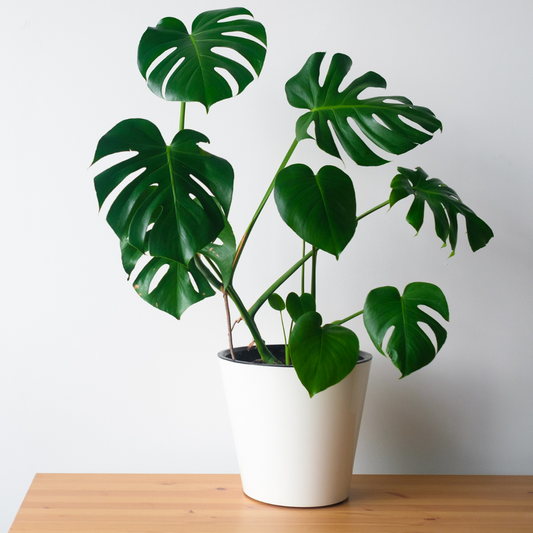
A Monstera Adansonii rewards you weekly. It throws out a new leaf, you notice, you feel competent. String of Pearls does not work that way. It rewards you in inches. A strand that was six inches in March is fourteen inches by September, and you cannot point to the day it happened.
That slowness is the appeal. It reads less like a houseplant and more like a piece of textile art that happens to be alive, a beaded curtain hanging in front of a window. And it has one flex almost nobody knows about until it happens to them. A mature, happy plant will throw small white brush-like flowers that smell distinctly of cinnamon. People tend to smell it before they see it and spend a while trying to work out where the spice is coming from.

The misconception that kills more of these than anything else
Here is the trap. It trails, so people water it like a Pothos.
It is not a Pothos. It is a desert succulent wearing a trailing plant's outfit. And because every pearl is a small water tank, the plant goes on looking completely healthy for weeks after the roots have already rotted. This is why people say theirs died suddenly. It did not die suddenly. It died slowly and had the reserves to hide it, and then one day the strands let go all at once.
So the care is short, and the one rule worth memorizing is a rule about restraint.
- Light: bright, with gentle direct morning sun very welcome. Thin, stretched-out strands with big gaps between pearls mean it wants more.
- Water: roughly every ten to fourteen days in summer, closer to monthly in winter. Soak, then let it dry out completely.
- Pot and soil: shallow pot, drainage hole non-negotiable, gritty succulent mix. The roots are shallow in the wild and a deep pot full of damp soil is a slow problem.
- Reading the pearls: wrinkled and slightly deflated means thirsty, and it will plump back up within a day of watering. Mushy, translucent or yellowing pearls mean overwatered, and by then you are usually looking at rot rather than thirst.
When in doubt, do not water. We say that plainly rather than softening it, because a plant that lives is the only outcome that works for anybody.
Propagation, and the trick that fixes a bald crown
String of Pearls propagates from stem cuttings, not from individual pearls. This catches out people who have propagated Echeveria or Jade by dropping a leaf on soil, because a single pearl will sit there and do nothing forever. You need a piece of stem with nodes on it.
Take four to five inches, let the cut end callus over for about a day, then either root it in water or push it straight into dry succulent mix and hold off watering for a week.
The trick worth saving is different, and it is the fix for the most common complaint about this plant, which is that the top goes bald while the strands get longer. Take a long strand, coil it flat across the surface of the soil, and press the stem gently into contact. It will root at every node that touches, exactly as it does on the ground in South Africa, and the crown fills back in. If you are repotting at the same time, a gritty mix with something like Organic Soil and Root Boost worked through it gives the new roots something to establish into.
Late August into September is the fastest rooting window of the year for both methods, while the plant is still in active growth and the soil is still warm.

Where it actually belongs in a room
This is a waterfall plant, and it wants height. A hanging planter at eye level, the end of a floating shelf, the top of a bookcase, the edge of a pedestal. Anywhere the strands can fall without touching anything, because the moment they land on a surface the illusion breaks and it reads like a plant that needs tidying.
The footprint is tiny and the visual return is enormous, which makes it one of the best options for a room where you have run out of floor. It sits comfortably alongside the rest of the trailing and hanging plants, and in a small apartment it earns its keep next to the desk and small space plants without competing for surface area.
If you want to build a whole shelf around the idea, the other two members of the unofficial string family are worth knowing. String of Hearts gives you fine silver-marbled foliage on thread-like vines, and String of Turtles gives you tiny patterned leaves on a much slower, denser trail. Three different textures, one visual idea. We wrote about the first of those in more depth in The Enchanting String of Hearts, and if you are working out how the whole arrangement should sit together, The Art of Indoor Plant Styling covers the composition side.
Why it lands as a gift
Most plant gifts get a polite reaction. This one gets an actual one, because the recipient has usually seen it on a screen and never in a room, and the difference between those two is significant.
It also keeps giving in a way very few gifts do. One healthy plant is a supply of cuttings, so the person you gave it to ends up handing rooted strands to somebody else six months later. That is a reasonable definition of a good present. It sits in our plant gifts collection for exactly that reason.
If you have a cat or a dog, read this part
String of Pearls is toxic to cats and dogs. The ASPCA lists it by its botanical name, Senecio rowleyanus, and describes stomach upset, mainly vomiting, along with lethargy if it is eaten. The sap can also irritate skin on contact, so it is worth rinsing your hands after taking cuttings.
Hanging it high genuinely helps, and it is one of the few toxic plants where the natural display style does most of the work for you. But a determined cat is a determined cat, and dropped strands end up on the floor. If you live with a serious chewer, we would rather you knew that now than found out later, and we would point you at the pet friendly houseplants instead. Our full breakdown of what is and is not safe lives in the pet safe houseplants guide.
How it gets to you
A plant made of strands is the kind of thing people assume will not survive a box, which is fair. Ours ship greenhouse-direct, so they are packed and moving within days of being pulled rather than sitting in a warehouse losing condition, and the strands are secured so they are not swinging loose in transit. Late summer also means no cold-shock risk, which matters more for a succulent from the Eastern Cape than for most things we send.
Every plant is covered by our 30-Day Guarantee.
The String of Pearls starts at $25.99 for a 4 inch pot, with a 6 inch available for anyone who wants length on day one. Or take a look through all of our plants if you are still deciding.
Frequently asked questions
Why is my String of Pearls dying?
Almost always overwatering. The pearls store enough water that the plant looks healthy for weeks after the roots have started to rot, which is why the collapse feels sudden. Check the soil first. If it is damp and the pearls are mushy or translucent rather than wrinkled, the problem is too much water, not too little. Take healthy cuttings from the ends of the strands while you still can and start those in dry succulent mix.
How often should I water String of Pearls?
Roughly every ten to fourteen days in spring and summer, and closer to once a month in winter. Rather than counting days, let the soil dry out completely and watch the pearls. Slightly wrinkled pearls are your signal to water, and they will plump back up within about a day.
How do I make my String of Pearls fuller?
Coil a long strand flat across the soil surface and press the stem into contact with it. It will root at every node that touches, filling in a bald crown without you having to buy a second plant. You can also plant several cuttings into one pot rather than one, which is how nurseries produce the dense look people expect.
Is String of Pearls toxic to cats?
Yes. The ASPCA lists it as toxic to both cats and dogs, with vomiting and lethargy as the main signs if it is eaten, and the sap can irritate skin. Hanging it well out of reach helps a great deal, but it is not a guarantee with a cat that is determined to climb.
Does String of Pearls flower?
It does, once it is mature and settled. The flowers are small, white and brush-like, and they carry a distinct cinnamon scent. They are not showy, and most people notice the smell before they spot the flower.