Most plants look the same on Tuesday as they did on Monday. A Monstera Thai Constellation does not. Every new leaf unfurls carrying a pattern of creamy flecks that has never existed before and will never repeat, scattered across deep green like stars thrown across a night sky. You can own this plant for five years and still not know what the next leaf will look like.
That is the whole appeal, and it is worth understanding why it happens, because the answer is stranger than most plant stories.

Thai Constellation at a glance
Monstera Thai Constellation is a variegated cultivar of Monstera deliciosa, developed in a Thai tissue culture laboratory rather than found in the wild. Its cream speckling is genetically stable, which means it will not revert to plain green. Here are the specifics worth keeping.
| Botanical name | Monstera deliciosa 'Thai Constellation' |
|---|---|
| Origin | Developed through tissue culture in Thailand, not a wild-collected plant |
| Light | Bright indirect light, and more of it than a green Monstera needs. No direct midday sun |
| Water | Roughly every 7 to 10 days indoors. Water when the top 2 inches of mix are dry |
| Humidity and temperature | 50 to 70% humidity, 65 to 80°F |
| Soil | Chunky aroid mix with orchid bark and perlite, never dense potting soil alone |
| Toxicity | Toxic to cats and dogs. Insoluble calcium oxalates (ASPCA) |
| Difficulty | Moderate. Easier to keep alive than to propagate |
| Availability at plantswagshop.com | Thai Constellation starts at $89.99 for the 4 inch pot, as of August 2026 |
What is a Monstera Thai Constellation, and where does it come from?
A Thai Constellation is a laboratory-developed cultivar of Monstera deliciosa, the same species as the common split-leaf Monstera, carrying a stable variegation mutation that produces cream and pale yellow speckling. It was developed and propagated in Thailand using tissue culture, which is why the country's name sits in the cultivar name.
This is the part that separates it from almost every other houseplant on the market. A standard Monstera Deliciosa traces back to wild populations in the rainforests of southern Mexico and Central America. A Thai Constellation traces back to a lab bench. Every single one in the world descends from cultured tissue rather than from a seed or a wild division, which is exactly why they arrive looking so consistent and why they have never been cheap. Growing one takes months of controlled laboratory work before it ever reaches a greenhouse.
If you want the wider context on why plants like this command the prices they do, our roundup of rare houseplants worth the hunt covers what collectors are actually buying right now. For the fundamentals of the parent species, the Monstera Deliciosa care guide is the place to start.
Why does Thai Constellation variegation never revert?
The speckled variegation on a Thai Constellation is genetically stable, meaning the mutation is present in every cell of the plant rather than in one cell layer. That is why it holds its pattern indefinitely and why any successful cutting will also be variegated.
Compare that to a Monstera Albo, the other famous variegated Monstera. Albo variegation is chimeral. Two different cell lines grow side by side, the ratio between them is always shifting, and a plant that produced gorgeous half-moon leaves last year can quietly revert to plain green this year. Owners of Albos manage that risk constantly by pruning back to variegated growth. Thai Constellation owners do not.

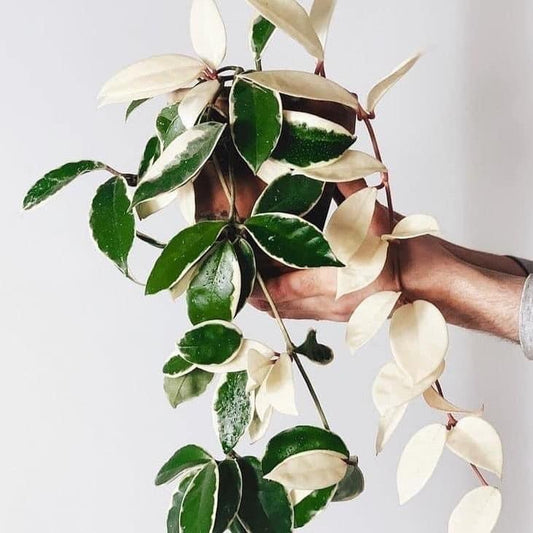
You can usually tell them apart by pattern shape. Albo variegation is blocky, with large white sectors and hard borders between white and green, as in the leaves above. Thai Constellation variegation is finer and more dispersed, closer to paint flicked off a brush.
One honest caveat. On high-color Thai Constellations that show both fine speckling and large solid cream sectors, only the speckling is the stable part. Those big creamy patches behave chimerally, the same way an Albo does, and they are not guaranteed to appear on every future leaf. Stable does not mean identical. It means the plant will never lose its variegation entirely.
How do you care for a Thai Constellation?
Give it bright indirect light, water roughly every 7 to 10 days once the top 2 inches of mix have dried, and pot it in a chunky aroid mix rather than dense soil. It is not a difficult plant. It is a plant with one specific need that people miss.
That need is light. The cream sections of the leaf contain little or no chlorophyll, so they cannot photosynthesize. A Thai Constellation is effectively running the same plant on less working leaf surface than a green Monstera, which means it needs a brighter position to do the same amount of work. A spot two or three feet from an east or north facing window is ideal.
What it cannot take is direct midday sun. Pale tissue has no pigment to protect it, so it scorches before the green sections show any stress at all, and the burn does not heal. If the white sections on your plant are browning at the edges, the two usual culprits are too much direct sun or dry air, not underwatering.
A few more specifics worth having:
- Humidity of 50 to 70%. Below about 40% the variegated margins crisp first. A pebble tray or a nearby humidifier is enough. Our late-summer reset guide covers how to adjust as light drops toward autumn.
- Support from the start. This is a climber. Give it a moss pole early and the leaves get larger and fenestrate sooner. Left to sprawl, it stays juvenile-looking for years.
- Feed lightly during the growing season. Half-strength balanced feed every four to six weeks from spring to early autumn, then stop. Overfeeding does not produce more variegation.
- Repot every two years or so. These are slow growers relative to a green Monstera, and they resent being disturbed too often.
Can you propagate a Thai Constellation from a cutting?
Yes, and any successful cutting will keep the variegation, because the mutation sits in every cell. The cutting must include a node, which is the small bump on the stem where a leaf and aerial root emerge. A leaf alone will never root into a new plant, and neither will an aerial root on its own.
Now the honest part, because most sources skip it. Thai Constellations are one of the harder Monsteras to propagate. Internodal spacing on this cultivar is tight, so the stem sections you get are short and stubby, with less stored energy and more cut surface relative to their size. That combination raises rot risk considerably. Water propagation in particular is unforgiving here.
If you want to try, take the cutting in the active growing season, include at least one node and ideally one leaf, let the cut surface callus for a few hours, and root into damp sphagnum moss or a very airy perlite mix rather than a glass of water. Expect it to take six to ten weeks and expect a lower success rate than you would get from a Monstera Adansonii, which roots almost carelessly by comparison. Our Adansonii spotlight is the better place to start if propagation is the part you enjoy.
The payoff is real, though. Propagate an Albo and you gamble on whether the cutting carries the variegated cell line. Propagate a Thai and the pattern is guaranteed.
Where should a Thai Constellation live in your home?
Put it where its pale sections catch bright ambient light without direct sun, give it a pole and vertical clearance, and surround it with solid deep greens so the marbling reads instead of competing. A Thai Constellation is an anchor plant, not a shelf filler.

Think about scale honestly before you buy. A 4 inch plant is compact and desk-friendly for its first year, but a mature climbing specimen on a pole reaches five to six feet indoors with leaves the width of a dinner plate. That is the version people fall in love with, and it needs floor space and headroom rather than a bookshelf.
For the plants around it, the rule is contrast without competition. Pair it with matte, solid, dark foliage so the eye reads the speckling as the event in the room. Philodendron Micans works beautifully for this, its velvet bronze-green absorbing light where the Thai reflects it. Monstera Dubia and Rhaphidophora Tetrasperma both echo the aroid leaf shape at a smaller scale without introducing a second variegated pattern. Avoid placing two heavily variegated plants side by side. They cancel each other out.
A pale wall behind the plant helps enormously. Cream foliage against a busy or dark background disappears.
Is a Thai Constellation a good gift?
It is an excellent gift for a specific person: someone who already owns the easy plants and has run out of things to want. It is a poor gift for a beginner, and price is not the reason. A first-time plant owner cannot yet read the difference between a light problem and a water problem, and this plant asks that question early.
For the collector, though, it lands the way few gifts do. It is instantly recognizable to anyone in the hobby, it carries a story worth retelling, and it does not become clutter. If you are shopping for someone earlier in their plant life, our plant gift collection has options that are easier to keep alive without feeling like a consolation prize.
One practical note on timing. Buying a rare tropical in August rather than November means it has warm weeks to settle into your home before light levels drop, which is a real advantage for a plant this sensitive to light. Every order ships greenhouse-direct with a heat pack when the weather calls for one, and every plant is covered by our 30-Day Guarantee.
Is Monstera Thai Constellation toxic to cats and dogs?
Yes. Monstera Thai Constellation is toxic to both cats and dogs. The ASPCA lists Monstera deliciosa as toxic, with insoluble calcium oxalates as the toxic principle, and the Thai Constellation is a cultivar of that same species, so the same warning applies without exception.
Chewing a leaf causes immediate oral irritation: intense burning of the mouth, tongue and lips, excessive drooling, vomiting, and difficulty swallowing. It is painful rather than usually fatal, and the pain itself tends to stop most animals after one bite. If you suspect ingestion, contact your veterinarian or the ASPCA Animal Poison Control Center at (888) 426-4435.
If you share your home with a curious cat, place this plant genuinely out of reach or choose differently. Our pet-friendly plant collection is filtered to non-toxic species, and there is no version of Monstera that belongs in it.
Why this plant gets under your skin
Here is the thing that makes a Thai Constellation different from an expensive object. In any other context, this plant is broken. A leaf that cannot photosynthesize across half its surface is a defect. In a wild population that mutation is a disadvantage, and the plant carrying it grows slower and competes worse than its plain green neighbours.
We took that flaw, decided it was the most beautiful thing about the plant, and built an entire industry around reproducing it faithfully. Every Thai Constellation on every windowsill exists because a lab in Thailand worked out how to keep a mistake alive on purpose.
And because the pattern is generated fresh in every leaf, you never stop being surprised by it. A pothos gives you more pothos. This plant gives you an unopened envelope every few weeks, and unrolling a new leaf to see where the cream landed is a small genuine pleasure that does not wear off. That is what people are actually buying.
If that is the plant you have been circling for a while, the Monstera Thai Constellation is in stock now in both 4 inch and 6 inch sizes, shipped greenhouse-direct. If you would rather browse the wider collector shelf first, the rare plants collection is where the hunt starts, and every live plant we carry lives one click further along.
Frequently asked questions
Why is the Thai Constellation Monstera so expensive?
Thai Constellation plants are expensive because they can only be produced through tissue culture in a laboratory, which takes months of controlled work per plant before it ever reaches a greenhouse. They also grow more slowly than green Monsteras, because the cream sections of each leaf contain little chlorophyll and contribute almost nothing to the plant's energy. Limited supply and slow production, rather than marketing scarcity, are what hold the price up. As of August 2026 a 4 inch Thai Constellation starts at $89.99 at plantswagshop.com.
Will a Thai Constellation lose its variegation over time?
No. Thai Constellation variegation is genetically stable, present in every cell of the plant rather than in a single cell layer, so the plant cannot revert to plain green the way a chimeral Monstera Albo can. The degree of variegation does vary from leaf to leaf, and large solid cream sectors on high-color specimens are not guaranteed to repeat, but the fine speckled pattern is permanent.
Does a Thai Constellation need more light than a regular Monstera?
Yes. A Thai Constellation needs brighter indirect light than a green Monstera deliciosa because the cream portions of its leaves contain little chlorophyll and cannot photosynthesize, leaving less working leaf surface to power the plant. A position two to three feet from an east or north facing window suits it well. Direct midday sun must still be avoided, because pale leaf tissue scorches permanently and cannot recover.
What is the difference between a Thai Constellation and a Monstera Albo?
The difference is the type of mutation. Thai Constellation variegation is genetically stable and appears as fine cream speckling spread across the leaf, and every cutting taken from one will be variegated. Monstera Albo variegation is chimeral, appears as large blocky white sectors with hard edges, can revert to plain green over time, and produces cuttings that may lose the pattern entirely.
Can you propagate a Thai Constellation, and will the cutting stay variegated?
Yes, a Thai Constellation can be propagated from a stem cutting that includes a node, and the resulting plant will always be variegated because the mutation exists in every cell. It is harder than propagating most Monsteras, however, because the tight internodal spacing on this cultivar produces short cuttings with less stored energy and a higher risk of rot. Rooting in damp sphagnum moss during the growing season gives better results than water propagation.
Why are the white parts of my Thai Constellation turning brown?
Browning on the cream sections of a Thai Constellation is almost always caused by direct sun or by dry air, not by underwatering. Pale leaf tissue has no pigment to protect it from intense light, so it scorches before the green sections show any stress, and that damage is permanent. Move the plant out of direct sun and raise humidity to between 50 and 70%. The damaged areas will not heal, but new growth will come in clean.
Is a Thai Constellation hard to care for?
A Thai Constellation is moderately difficult, and it is considerably easier to keep alive than it is to propagate. Its one demanding requirement is bright indirect light, because the variegated portions of the leaf cannot photosynthesize. Beyond that it wants a chunky aroid mix, watering every 7 to 10 days once the top 2 inches are dry, humidity between 50 and 70%, and a moss pole to climb.