Somewhere around dusk, without any warning and without any help from you, the leaves start to rise. By full dark they are folded upright and pressed together, and the plant that spent all day spread flat and open across your shelf now looks like a small pair of hands held in prayer. In the morning it opens again. It will do this tonight, and tomorrow night, and every night after that.
Here is the part almost nobody tells you: it is not reacting to the light going out. Put a Maranta in a sealed, permanently dark room and it keeps folding and unfolding on roughly the same schedule anyway. The plant is not watching the sunset. It already knows.
That single fact is why the Maranta 'Lemon Lime' is one of the most quietly remarkable plants you can keep in a house, and why it deserves more than the light-water-humidity treatment it usually gets.

The leaves move on a clock, not a light switch
The movement has a name: nyctinasty. It describes the daily opening and closing that some plants perform on a rhythm tied to day and night. Prayer plants are the most famous houseplant example, and they are famous for a reason. Most plants that visibly move are moving because something is wrong. A drooping Calathea is thirsty. A curling Pothos is stressed. This one moves because it is Tuesday evening.
The mechanism is genuinely elegant. At the base of each leaf, where the blade meets the stalk, there is a small swollen joint called a pulvinus. Inside it sit motor cells that do one job: move water. When those cells are full and firm, they push the leaf out flat. When they release water and lose that firmness, the tissue slackens on one side and the leaf swings upward like a hinge. No muscle, no nerve, just water pressure being shifted from one bank of cells to another.
What decides the timing is a circadian clock inside the plant, calibrated by light-sensitive proteins called phytochromes. Falling light in the evening keeps that clock set to your local sunset, which is why the folding lines up so neatly with your own evening. But the clock is the thing running the show. Take the light cue away entirely and the rhythm persists for days, drifting slowly out of sync the way a wristwatch does when nobody resets it. This is the detail that gets flattened in almost every article written about this plant, which will tell you the leaves "close in response to darkness." They do not. They close because the plant expects darkness.
As for why a plant would bother, the accepted explanation is a mix of practicality: folded leaves shed rainwater more efficiently, lose less moisture overnight, and present a smaller target to whatever is crawling around the forest floor after dark. It is presented as the best current reading rather than a closed case, which is fair, because the honest answer is that the adaptive value is easier to describe than to prove.
Where it comes from, and why that explains your living room
Maranta leuconeura is native to the tropical rainforests of Central and South America, with the species most strongly associated with Brazil. The genus name honours Bartolomeo Maranta, a sixteenth century Italian physician and botanist, which is a nice piece of trivia and also a reminder that people have been paying attention to this plant for a very long time.
The more useful piece of the origin story is where it grows. Maranta is an understory plant. It lives low and spreading on the forest floor, underneath a canopy that has already taken most of the light before any of it reaches ground level. Everything about how it behaves in your home follows from that. It tolerates the dim corners that kill a fiddle leaf fig because dim is its native condition. Direct sun scorches it and bleaches the colour out of the banding because direct sun is something it evolved to almost never encounter. If you have ever wondered why some plants sulk in a north-facing room and others seem faintly relieved, this is the whole answer, and it is worth reading alongside our room by room guide to how much light a plant actually needs.
There is a satisfying consequence here. Healthy folding tends to kick in as ambient light drops into the range of roughly ten to twenty foot-candles, which is genuinely dim. That makes a Maranta something close to a living light meter. If it folds early in the evening, your room goes darker sooner than you think. If it never quite folds at all, there is more light in that room at night than you realised, usually from a lamp you leave on or a streetlight through a thin curtain.
What 'Lemon Lime' actually is
Most people meet this genus through the Red Prayer Plant, the one with the crimson herringbone veins running out from the midrib. 'Lemon Lime' is the same species wearing a completely different palette: deep forest green blades, broad lime and chartreuse banding chevroned along the centre, and pale green veining where the red version has red. In low light the contrast reads almost fluorescent.
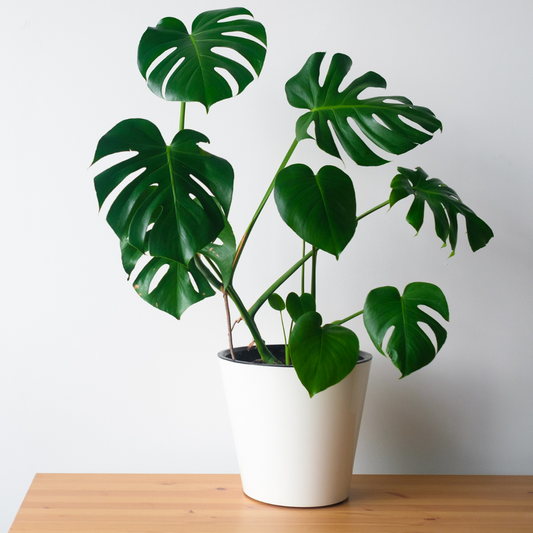
Competitor guides tend to treat this as a colour swap and move on. In practice the cultivar changes how you use the plant. Red venation reads as warm and traditional and disappears into a busy room. Lemon Lime reads as bright and graphic and holds its own against white walls, pale wood and the kind of flat modern surfaces most homes actually have. If you like plants whose entire personality is one defining visual trait, it sits in the same family of appeal as the Monstera Thai Constellation, though the two get there by very different routes.

Care, kept short
This is not a care guide and the plant does not need one. Five things carry almost all of the outcome.
Light. Medium to low indirect. An east window set back a few feet, or a north window, or a bright room with no direct beam falling on the leaves.
Water. Every one to two weeks, when the top half of the soil has dried. Overwatering is the single most common way this plant dies, usually through leaf spot first and root rot after.
Water quality. This is the tip that separates people who succeed with Marantas from people who quietly give up on them. The genus is sensitive to hard tap water and to the fluoride and chlorine in most municipal supply. Filtered water, or tap water left sitting out overnight, prevents a lot of the crispy brown edging that gets blamed on humidity.
Humidity and temperature. Normal room humidity is workable and more is better. Keep it between sixty five and eighty five degrees Fahrenheit and do not let it sit below sixty. If you want to push the humidity properly, our guide to houseplant humidity covers what works and what is theatre.
| What you see | Most likely cause | What to do |
|---|---|---|
| Leaf edges curling with brown crisp tips | Dry air, or minerals in tap water | Switch to filtered or rested water, raise ambient humidity |
| Colour washed out, pale blotching | Too much direct sun | Move back from the window or filter the light |
| Yellowing leaves, soft or mushy stems | Overwatering | Stop watering, let the top half dry fully, check drainage |
| Small brown spots with yellow halos | Leaf spot from water sitting on foliage | Water the soil, not the leaves, improve airflow |
| Leaves stay open at night | Ambient light at night, or a very stressed plant | Remove the light source, then check watering |
Making more of it
A plant built to spread sideways across a forest floor is, by design, a plant that is easy to multiply. There are two reliable routes.
Stem cuttings. Cut just below a node, which is the slightly thickened point where a leaf joins the stem. Strip the lowest leaves so the node is exposed, then root the cutting in water or push it straight into moist soil. Roots typically appear in two to four weeks in water. Water rooting is the more satisfying method to watch and the slightly more fragile one to transplant.
Division. The faster and lower risk option. At repotting time, tease the root ball apart into clumps, each with its own roots and a few leaves, and pot them separately. Because the plant naturally grows as a low spreading mat, it usually comes apart with very little argument.
Either way, do it in spring or summer when the plant is actively growing, keep humidity up while the new roots establish, and expect the first few weeks to look unimpressive.
Where to put it so you actually see the trick
At maturity this is a low, wide plant: roughly twelve inches tall and spreading twelve to eighteen inches across. That shape tells you what it is for. It is not a floor plant and it is not a corner-filler. It is a shelf, side table, desk and coffee table plant, and it looks best where you can see the top surface of the leaves rather than the underside.
The placement rule that matters, though, comes straight from the hook. Put it where you will actually be standing at both ends of the day. A Maranta on a high shelf in a room you pass through twice a week wastes its entire party trick, because the entire party trick happens at dusk and at dawn. Two placements pay off reliably:
- Bedside table. You are present at the exact two moments the plant does something. It is a genuinely calming last thing to see.
- Desk, at eye level or just below. If you work into the evening you get to watch it close in real time, which is the fastest way to convince a sceptic that plants are doing more than sitting there.
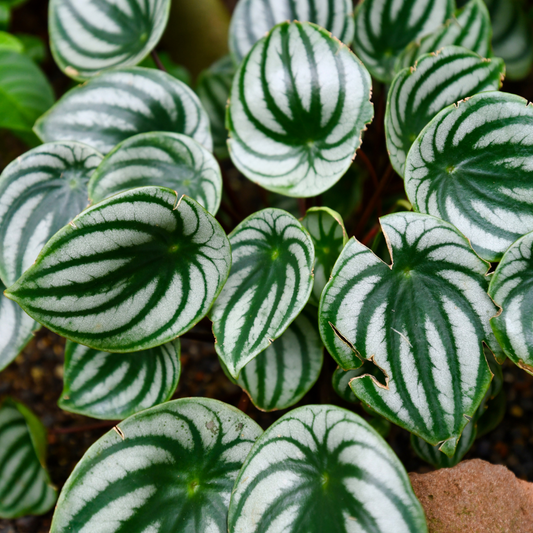
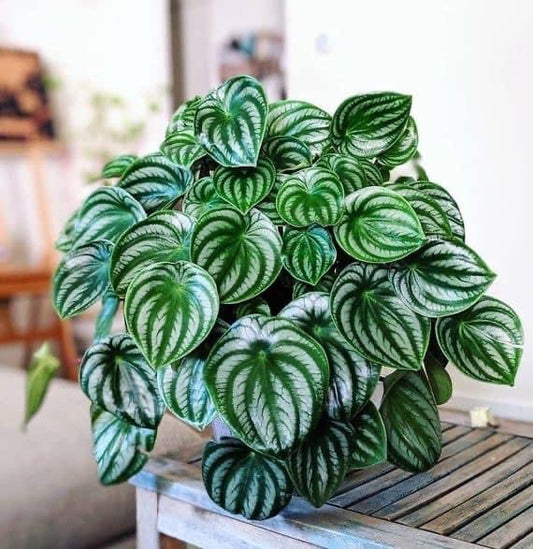
For pairing, stay inside the same light band so you are not fighting two different care routines in one vignette. Calathea 'Ornata' at $17.99 has the same understory feel with pinstripe rather than chevron. Calathea Lancifolia 'Rattlesnake' at $22.99 brings wavy edges and a taller silhouette to break up a flat shelf. If you want a third texture that stays small and rounded, Peperomia Watermelon at $22.99 does the job. All three sit comfortably in the same low light collection.

The best gift for someone who thinks they kill plants
There is a specific person this plant is almost unfairly good for: the one who says, cheerfully and with total conviction, that they cannot keep anything alive.
The reason most beginners fail is not skill. It is feedback. A Snake Plant or a ZZ can sit unchanged for six weeks, giving a nervous new owner absolutely no information about whether they are doing well or slowly killing it. In the absence of feedback, people either overwater out of anxiety or forget the plant entirely. Both end the same way.
A Maranta gives feedback every single evening. It moves. It responds. It very visibly does something, and that something has nothing to do with whether the owner is getting it right, which means it reads as reassurance rather than as a test. Confidence follows, and confidence is what actually keeps a first plant alive past month three.
That makes it a strong housewarming gift, a strong first-apartment gift, and a strong gift for anyone starting something new and slightly daunting. At $20.99 for the four inch pot it also sits at a price that works as a real present without becoming a gesture. If you would rather give something that keeps arriving, the plant subscription boxes cover the same instinct on a longer timeline.
Safe around cats and dogs
The ASPCA lists Maranta leuconeura as non-toxic to cats, dogs and horses. That is checked against the botanical name rather than a shop label, which matters, because plenty of plants get tagged pet friendly on looser evidence than that.
One honest caveat. Non-toxic is not the same as digestible. A cat that eats a serious quantity of any plant material can still end up with an upset stomach, and a chewed Maranta stops being a handsome plant fairly quickly. Put it somewhere a determined animal cannot use it as salad, and everyone stays happy.
Beyond that, this is one of the genuinely unambiguous entries in the catalogue, which is not something we can say about every plant that gets marketed to pet owners. The rest of the properly verified list lives in the pet friendly collection, and the reasoning behind how those calls get made is in our complete non-toxic guide for cats and dogs.
What you are really buying
Most houseplants are decoration that happens to be alive. You put them somewhere, they look good, and the relationship is entirely one directional.
This one keeps its own time. It inherited a rhythm from a forest floor in South America and it is still running that rhythm in a room in your house, on a schedule set long before you owned it, whether or not anyone is in the room to watch. Right now that schedule is about to get more visible rather than less: as the evenings come in earlier through September and October, the folding starts earlier and you catch more of it.
Every plant ships greenhouse-direct, and every order is backed by our 30-Day Guarantee. Free shipping starts at $149. If you want to start with the plant this whole piece is about, the Maranta 'Lemon Lime' starts at $20.99 for the four inch pot, and there is plenty more in the easy care collection and across every plant we grow.
You did not buy a decoration. You bought something with a schedule.
Frequently asked questions
Why do prayer plant leaves fold up at night?
The folding is called nyctinasty. At the base of each leaf there is a joint called a pulvinus, filled with motor cells that move water in and out. When those cells lose pressure the leaf swings upward and closes. The timing is set by an internal circadian clock, calibrated by falling evening light through light-sensitive proteins called phytochromes. Crucially the clock, not the darkness, is what drives it, which is why the rhythm continues for days even in constant darkness.
Is Maranta 'Lemon Lime' toxic to cats or dogs?
No. The ASPCA lists Maranta leuconeura as non-toxic to cats, dogs and horses, so it is safe to keep in a home with pets. Non-toxic does not mean digestible, though, and an animal that eats a large amount of any plant material may still get an upset stomach.
How often should I water a Lemon Lime prayer plant?
Roughly every one to two weeks, once the top half of the soil has dried out. Check with a finger rather than a calendar, because pot size, light and room temperature all change the pace. Use filtered water or tap water left out overnight, since this genus is sensitive to the minerals and chlorine in hard tap water.
Why are my prayer plant leaves curling with brown tips?
Two usual suspects. Dry air is the first, and the fix is more ambient humidity rather than misting. Water quality is the second and more commonly missed one: hard tap water leaves mineral and fluoride residue that burns the leaf margins over time. Switching to filtered or rested water often clears it up within a few new leaves.
Can you propagate a prayer plant in water?
Yes. Take a cutting just below a node, strip the lowest leaves so the node is exposed, and set it in water. Roots usually show in two to four weeks. Move it to soil once the roots reach an inch or two. Division at repotting is the faster and lower risk alternative, since the plant grows as a spreading mat and separates easily.
What is the difference between Maranta 'Lemon Lime' and the Red Prayer Plant?
They are cultivars of the same species, Maranta leuconeura, and their care is effectively identical. The difference is colour. Red Prayer Plant has crimson herringbone venation running from the midrib. 'Lemon Lime' replaces that with lime and chartreuse banding and pale green veins, which reads far brighter in a dim room and holds up better against pale modern interiors.
Do prayer plants need high humidity?
They prefer it, but normal indoor humidity is workable. Grouping plants together, using a pebble tray, or running a small humidifier nearby all help more than misting, which raises humidity for only a few minutes and can encourage leaf spot if water sits on the foliage.
Why is my prayer plant not folding at night?
Most often there is simply too much light in the room after dark. A lamp left on, a television, or a streetlight through thin curtains can be enough to keep the leaves open. Move the plant away from the source or draw a heavier curtain. If the room is genuinely dark and the leaves still stay flat, look at watering and root health next, since a badly stressed plant will drop the rhythm.