
You hung the shelf on a Saturday. You set the pot slightly off center, tucked one vine forward so it caught the light, and took the photo.
Six months on, the vine is resting on the back of a chair.
Here is what nobody tells you when they teach shelf styling: you did not style a shelf, you started one. A trailing plant is the only object in the room that keeps moving after you put it down, and the arrangement you built on day one is a snapshot of that plant at the shortest it will ever be.
Quick answer: style a trailing plant shelf for the length the plant will reach in six to twelve months, not the length it arrives with.
Measure the vertical clearance below the shelf before you choose the plant, not after.
Under 12 inches of clearance, choose slow or compact trailers. Over 36 inches, choose fast runners.
Pruning is a styling choice with a real cost: every cut trades length for fullness.
Why does a shelf that looked right in spring look wrong by autumn?
Because a trailing plant has a growth vector and your composition does not. Six months on, one of exactly three things has happened, and only one is styling.
- It got better. There was open air below the shelf, the drop had somewhere to go, and the arrangement grew into itself.
- It got cramped. The shelf sat above a chair back, a cabinet or a countertop, the vine hit an obstacle, and it now reads as accidental rather than deliberate.
- It got cut. You pruned to protect the original composition, which means you spent six months of growth staying exactly where you started.
Outcomes two and three are not plant problems. They are placement decisions made once, quickly, with no information about what the plant would do next.
How much clearance does your shelf actually have?
Clearance is the uninterrupted vertical distance from the lip of the shelf down to the first thing that will stop a vine. Not the floor. The first obstacle. Measure it before you shop and let that number choose the plant, because clearance decides whether the plant still looks intentional at month twelve.
| Clearance below the shelf | What that space needs | Trailing plants that fit | Time for the drop to fill |
|---|---|---|---|
| Under 12 inches | Compact or genuinely slow growers that will not overrun the gap | Hoya 'Curtisii', Peperomia 'Hope' | 12 months or more, and that is the point |
| 12 to 36 inches | Moderate pace, textural interest, forgiving of a trim | Pothos 'N' Joy', Scindapsus pictus 'Exotica', Hoya Rope Plant | 6 to 12 months in bright indirect light |
| Over 36 inches | Fast runners with real length to give | Pothos 'Golden', Spider Plant Reverse | 4 to 8 months in bright indirect light |
Every pace above assumes bright indirect light. A Golden Pothos in a dim hallway is not a fast plant. Light sets the clock; clearance sets the target.
Under 12 inches of clearance: which trailing plants stay short?
Most people get this bracket wrong, because a short gap looks like it needs a small plant when it actually needs a slow one. A fast plant in a 10 inch gap is a pruning schedule you did not agree to.
Hoya 'Curtisii' is the honest answer here. A miniature Hoya with small speckled leaves tightly spaced along the stem, it grows genuinely slowly and holds a compact shape for years. Non-toxic to cats and dogs per the ASPCA, which matters more on a low shelf than a high one.
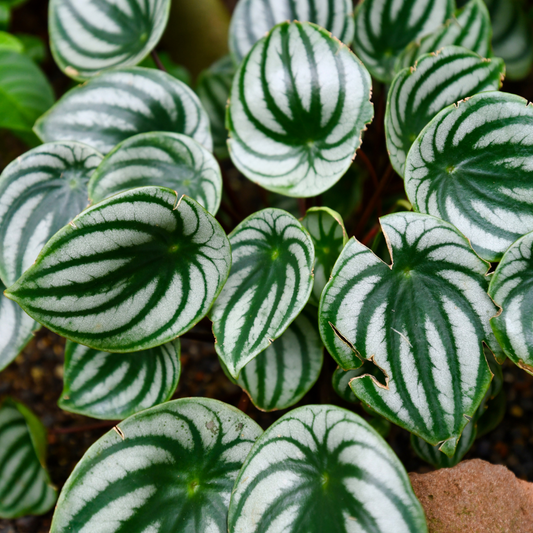
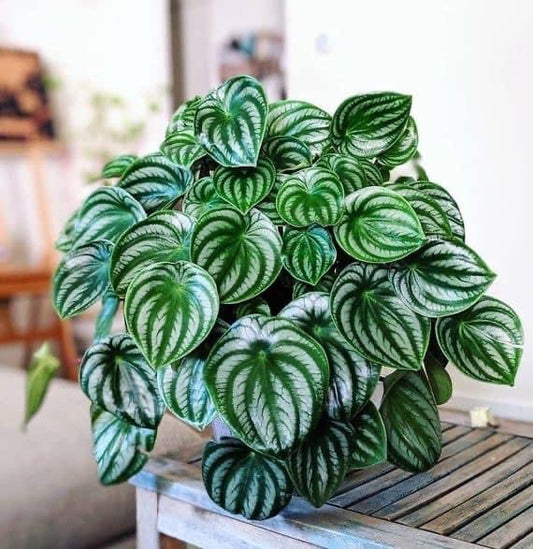
Peperomia 'Hope' (Peperomia tetraphylla) trails in short, thick, coin-leaved strands rather than running. It fills outward before it falls, so at month six you get a fuller pot rather than a longer vine. Also non-toxic to pets.

12 to 36 inches: the workable middle
A standard floating shelf on an open wall sits in this range, and so does the top of most bookcases. Almost every trailing plant looks correct here at month six, so reserve this bracket for the most interesting texture rather than the fastest growth.
Pothos 'N' Joy' (Epipremnum aureum 'N' Joy') grows at a moderate pace with crisp white and green variegation that stays legible from across a room. It is toxic to cats and dogs per the ASPCA, so keep the drop above nibbling height.
Scindapsus pictus 'Exotica' carries broad matte leaves with silver splashes, and it drapes rather than dangles, which reads as considered even when it is overdue a trim. Also toxic to pets.
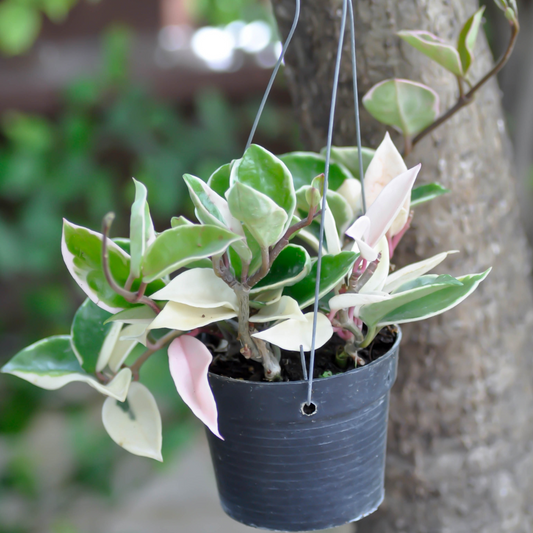
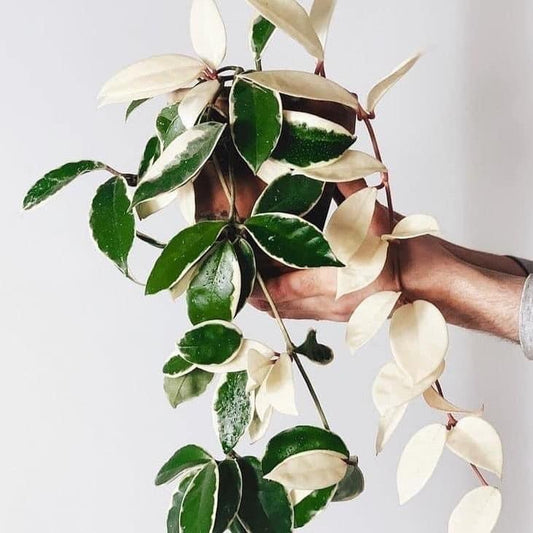
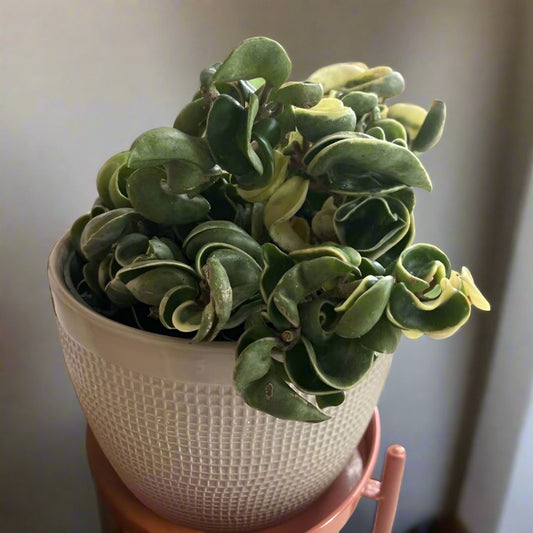
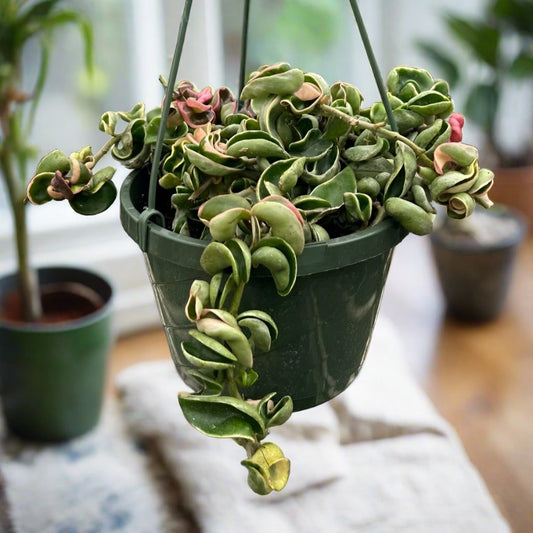
Hoya Rope Plant (Hoya carnosa 'Compacta') is the sculptural option: twisted, curled leaves stacked along a stem slow enough to hold a shape for years. Non-toxic to pets, and worth browsing alongside the rest of the Hoyas if you want length on a slower schedule.
Over 36 inches: plants that need the full fall
A high shelf, a stairwell wall or a proper hanging position. This is the only bracket where a fast, long runner reads as intentional rather than overgrown, and it is where most people should have put their pothos in the first place.
Pothos 'Golden' is the fastest plant in this set and will happily run several feet in bright indirect light. Give it the height and it becomes a curtain. Give it 14 inches and it becomes a chore. Toxic to cats and dogs per the ASPCA.
Spider Plant Reverse (Chlorophytum comosum) behaves differently from the vines: it throws pups on arching stems, so it gains bulk and silhouette as well as length. It is non-toxic to cats and dogs, which makes it the safest choice on this page for a home with a curious animal.

Should you prune a trailing plant to keep the arrangement?
Yes, but only if you accept what you are buying. Every cut trades length for fullness. Pruning just above a leaf node makes the plant bushier and shorter, because growth redirects into new points near the cut. Leaving it alone makes it longer and thinner.
Neither is wrong. What is wrong is doing it by accident and never noticing you have chosen the bushy version of a plant you bought for its drop. Decide once, in advance:
- Keep the composition. Trim above a node every few months, accept a fuller and shorter plant, and treat the shelf as a fixed picture you maintain.
- Keep the growth. Let it run and reposition the pot as the drop lengthens instead of cutting it back.
- Move it. If the plant keeps outgrowing the gap, relocate it to a bracket that fits and put something slower in the original spot.
Cuttings root readily in water for most of the plants above, which is the quiet upside of one that outgrows its shelf.
Where to start if you are choosing today
Measure the gap first, then pick from the bracket rather than from the photo. Shipping greenhouse-direct, we see the same pattern constantly: the plants that disappoint at month six are almost never unhealthy, just in the wrong bracket, doing what they were always going to do.
For the composition side, our guide to building a corner from three plants covers arrangement and the shelfie walkthrough covers the build. For a trailer whose whole appeal is the strand, the String of Pearls piece is the deeper read.
Every order is backed by the 30-Day Guarantee. Browse the full Trailing and Hanging Plants range, or the wider plant catalogue if you are still deciding what the shelf is for.
Frequently asked questions
How much clearance does a trailing plant need below a shelf?
A trailing plant needs enough uninterrupted vertical space below the shelf for the length it will reach in six to twelve months, not the length it has today. Under 12 inches of clearance suits compact or slow growers such as Hoya 'Curtisii' and Peperomia 'Hope'. Between 12 and 36 inches suits moderate growers such as Pothos 'N' Joy' and Scindapsus pictus 'Exotica'. Over 36 inches is where fast runners such as Golden Pothos look intentional rather than overgrown.
How fast do trailing houseplants actually grow indoors?
Growth pace depends far more on light than on the plant. In bright indirect light a Golden Pothos can add several feet in a single growing season, while a Hoya 'Curtisii' may take more than a year to fill a 12 inch drop. In low light the same plants slow dramatically, so treat any growth estimate as a bright indirect light figure and adjust it downward for a dim room.
Are trailing houseplants safe around cats and dogs?
It depends entirely on the species, and category tags are not a reliable guide. Pothos varieties (Epipremnum aureum) and Scindapsus pictus are both listed as toxic to cats and dogs by the ASPCA. Spider Plant (Chlorophytum comosum), Hoya carnosa and Peperomia species are listed as non-toxic. Always check the botanical name rather than the common name before placing a trailing plant within reach of an animal.